5 Best Wooden Salad Bowls for 2026: Top Picks & Guide

Table of Contents
- 5 Best Wooden Salad Bowls for 2026 at a Glance
- How We Chose the Best Wooden Salad Bowls
- The Best Wood for Salad Bowls: Acacia, Teak, and More
- 1. ForestCraft Teak Salad Set: Best Overall
- 2. ForestCraft Acacia Serving Bowl Collection: Best for Entertaining
- 3. ForestCraft Acacia Mixing Bowls: Best for Everyday Use
- Choosing a Large Wooden Salad Bowl for Family-Size Salads
- Why a Wooden Salad Bowl Set With Servers Makes Serving Easier
- Frequently Asked Questions
Last Updated: November 5, 2026
5 Best Wooden Salad Bowls for 2026 at a Glance
A wooden salad bowl earns its place on the table through material, size, and finish, and the right pick depends on how you actually serve. This guide from Amari compares three ForestCraft options side by side, all priced at $89.99, so the choice comes down to use rather than budget.
Here is the short version before the detail:
Pick |
Best For |
Material |
Price |
|---|---|---|---|
Best overall |
Teak |
$89.99 |
|
ForestCraft Acacia Serving Bowl Collection |
Entertaining |
Acacia |
$89.99 |
ForestCraft Acacia Mixing Bowls |
Everyday use |
Acacia |
$89.99 |
The three picks below cover the range most households need: one set built for dressing and tossing, one for presenting food to guests, and one for daily prep. Each is available as a set or as individual pieces, so a collection can grow over time.

How We Chose the Best Wooden Salad Bowls
Selection here comes down to four practical tests: wood species, construction, finish, and how the bowl behaves once dressed greens hit it. A salad bowl holds wet, acidic food and gets washed often.
Teak and acacia lead this list because both appear in the ForestCraft collection. Teak carries natural oils that help it resist moisture, which matters for a bowl that meets vinaigrette regularly. Acacia offers a harder, denser surface with strong grain character.
Every pick was judged on whether it works for mixing, serving, or both, and whether it suits a household of two or a table of eight.
The Best Wood for Salad Bowls: Acacia, Teak, and More
The best wood for a salad bowl balances three things: how hard the surface is, how tightly the grain is packed, and how the wood behaves when it meets water, acid, and heat.
Teak is a dense, naturally oil-rich hardwood. The oils sit inside the wood rather than on the surface, which is why teak has a long history in ship decks, outdoor furniture, and serving pieces that see frequent contact with liquid.
Acacia is a harder, denser wood with a more dramatic grain. Density matters because a salad bowl gets scraped by serving spoons, stacked in cabinets, and washed repeatedly.
Hardness and Grain: What Each Wood Brings to the Table
Hardness is usually measured on the Janka scale, which records the force needed to embed a steel ball halfway into a wood sample. Teak and acacia both sit well above softer woods like pine or basswood, which is why both are common in serving ware.
Grain structure matters for a different reason. Open, wide grain, the kind acacia often shows, gives a bowl its visual character but also creates more surface area for water to reach. Tight, even grain, the kind teak usually shows, is calmer visually and slightly easier to keep sealed with oil. Neither is automatically better.
How Each Wood Handles Acid, Heat, and Repeated Washing
Salad is a demanding test. Vinaigrette is acidic, tomatoes and citrus add more acid, and salt pulls moisture around. A wooden bowl that meets dressed greens several times a week needs to tolerate that cycle without dulling, staining, or developing a rough surface.
- Acid: Both teak and acacia handle normal vinaigrette contact well when the surface is properly oiled. A dry, un-oiled surface is where trouble starts, because acid and pigment can reach bare wood and stain it.
- Heat: Neither wood belongs in a microwave or under a broiler. Warm food is fine; hot food straight from a pan is not, because heat drives moisture out of the wood unevenly and can open small cracks.
- Washing: Hand washing in warm water with a mild soap is the standard for both. A dishwasher cycle combines heat, prolonged water exposure, and harsh detergent, which is the combination most likely to dull the finish and stress the wood.
Other Woods You May See, and Where They Fit
Teak and acacia are not the only options. Olive wood shows dramatic swirling grain and is often used for smaller serving pieces. Walnut is softer in tone and works well on tables that lean warm and muted. Pakkawood, a resin-impregnated wood composite, is denser and more uniform than solid wood and shows up in some serving tools. Each brings a different look and feel in the hand.
Hardness alone does not decide quality. Construction, finish, and care matter just as much, which is why the picks below weigh all three.
1. ForestCraft Teak Salad Set: Best Overall
The ForestCraft Teak Salad Set takes the top spot because it is built for the exact job a salad bowl does: holding dressed greens and serving them at the table.
Teak's natural oil content makes it a natural fit here. The wood resists moisture, which matters when vinaigrette, citrus, and salt sit in the bowl through a long dinner.
U.S. Department of Agriculture guidance on wood and food contact
The warm teak grain gives the bowl a finished look that works on a weeknight table and a holiday one alike. Delivered in 8-10 business days.
Households that want one set to mix, toss, and serve without switching bowls between the kitchen and the table.
2. ForestCraft Acacia Serving Bowl Collection: Best for Entertaining
Hosting changes what you need from a bowl. One large piece is rarely enough when a table carries salad, sides, bread, and dessert at once.
The ForestCraft Acacia Serving Bowl Collection answers that with three beautifully handcrafted bowls in complementary sizes, this thoughtfully curated set is designed to help you serve everything from fresh berries and snacks to side dishes, desserts, and family favorites.

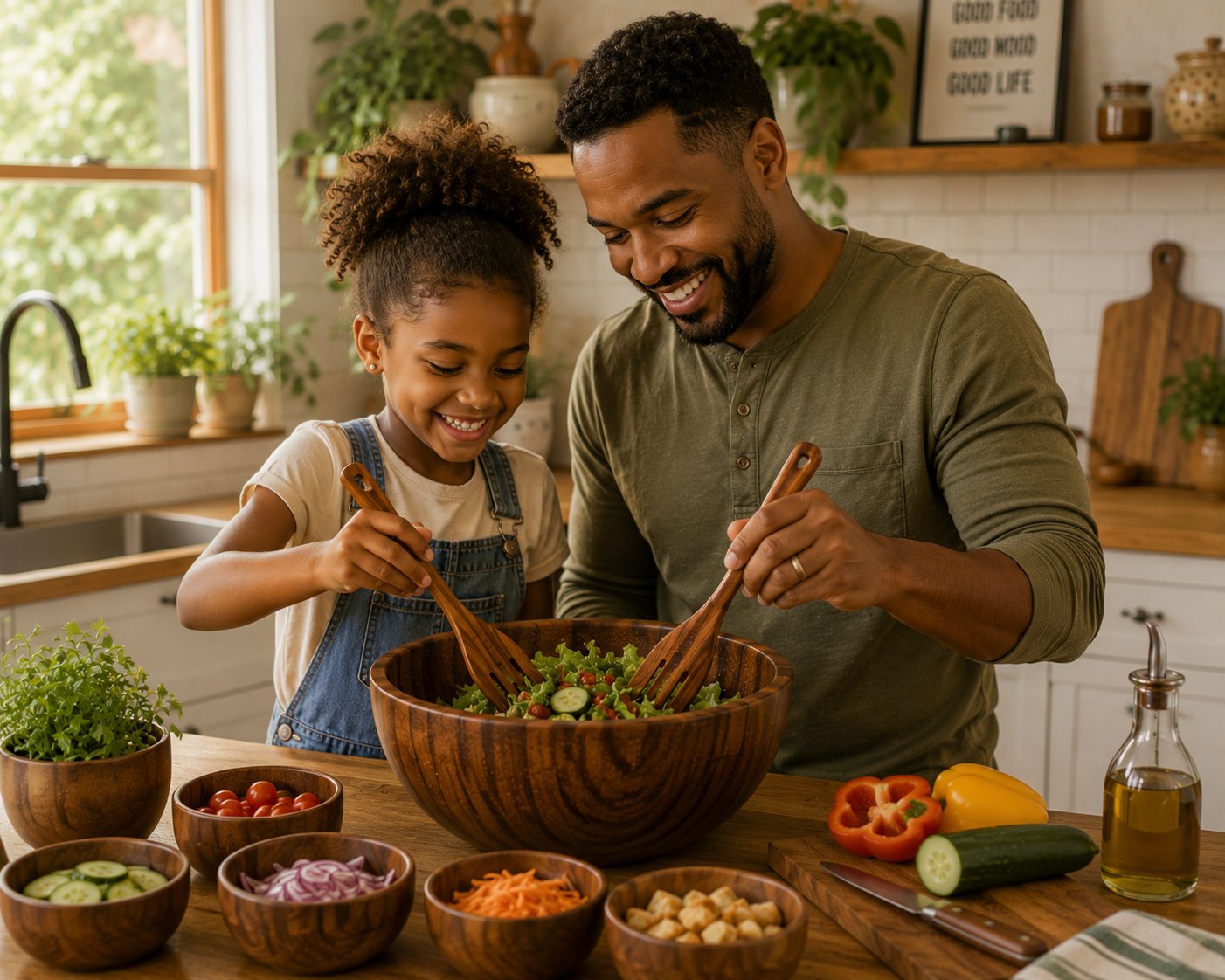
Crafted from durable acacia wood, each bowl showcases its own unique grain pattern, because acacia has its own natural grain, no two pieces are exactly alike.
3. ForestCraft Acacia Mixing Bowls: Best for Everyday Use
Daily cooking asks more of a bowl than a holiday table does. It gets used for whisking, tossing, and prepping, then washed and put back to work the next day.
ForestCraft Acacia Serving Bowl →
ForestCraft Acacia Mixing Bowls are handcrafted from beautifully grained acacia wood, naturally durable, food-safe, and warm enough to leave on your counter between uses.

The acacia grain gives each bowl a distinct look, so a stack on the counter reads as a set of individual pieces rather than a matched stack. Delivered in 8-10 business days.
Choosing a Large Wooden Salad Bowl for Family-Size Salads
A large wooden salad bowl is a capacity decision before it is a style one. Too small, and greens spill over the rim the moment they are tossed. Too large, and a side salad looks lost in the bottom. A more useful approach than a headcount chart is to think in terms of volume, depth, and how the bowl will actually be used.
Start With Volume, Not Diameter
Diameter tells you how much table the bowl takes up. Volume tells you how much salad it holds. A wide, shallow bowl and a narrower, deeper bowl can share the same diameter and hold very different amounts of food.
As a rough guide, dressed greens lose volume as they are tossed, so a bowl that looks full of loose leaves will settle to roughly two-thirds of that once dressing is worked through. A bowl rated for a given volume will serve slightly fewer people than the label suggests if the salad is heavily dressed or includes dense ingredients like chickpeas, grains, or roasted vegetables.
A practical way to size a bowl:
- Side salad for two: roughly 2 to 3 quarts of usable volume
- Main-course salad for four: roughly 4 to 5 quarts
- Shared side for six to eight: roughly 6 quarts or more, or two medium bowls
- Family that eats salad most nights: a 5- to 6-quart bowl is the sweet spot, large enough for a main-course salad but not so large that a side salad disappears
Depth Matters as Much as Width
Depth is what keeps dressed greens contained during tossing. A deeper bowl gives you room to work without chasing leaves across the counter. A shallow, wide bowl presents food beautifully but offers less room to toss, which is why shallow bowls tend to work better for serving than for mixing.
A useful rule of thumb: a bowl that is roughly as deep as it is wide at the rim will toss and serve well. A bowl that is noticeably wider than it is deep is a presentation piece first.
Match the Bowl to the Crowd
- Two people: a medium bowl handles a side salad with room to toss
- Four to six: a large bowl covers a main-course salad or a shared side
- Eight or more: pair a large bowl with a second serving piece, or use a coordinated set
A Side-by-Side Way to Compare Bowls
When comparing two bowls online, the most useful numbers are diameter, depth, and stated capacity. If a listing gives only one of the three, treat the others as unknown rather than assuming.
Weight is worth checking too. A heavier bowl stays put while you toss with one hand and hold the rim with the other. A very light bowl can slide on a smooth counter.
U.S. Food and Drug Administration food contact substance information
For a family that eats salad most nights, a large teak or acacia bowl earns its counter space. For occasional hosting, a coordinated set of serving bowls covers more of the table.
Why a Wooden Salad Bowl Set With Servers Makes Serving Easier
A wooden salad bowl set with servers solves a problem single bowls create: the right bowl with the wrong tools.
The practical case for a set comes down to three things:
- Matched utensils that suit the bowl's size and depth
- A consistent look on the table without extra shopping
- Fewer pieces to store than a bowl and separate servers bought alone
U.S. Environmental Protection Agency information on wood products
The ForestCraft Teak Salad Set covers this directly, arriving as a bowl-and-utensil set or as individual pieces. For a host building a table over time, that flexibility matters.
Wooden salad bowl care keeps any of these picks in service for years. Hand wash in warm water, dry promptly, and re-oil occasionally to keep the surface from drying out. Skip the dishwasher entirely.
Frequently Asked Questions
What is the best wood for a salad bowl?
Teak and acacia are two of the most practical choices. Teak is naturally oil-rich and moisture-resistant, which suits bowls that regularly meet dressings and washed greens. Acacia is dense and shows distinctive grain, so each bowl looks slightly different.
Are wooden salad bowls safe for serving food?
Yes, when the bowl is finished for food contact and cared for properly. Wash the bowl by hand with mild soap and warm water, dry it right away, and re-oil it when the wood starts to look dry.
How do you clean and care for a wooden salad bowl?
Hand wash with mild soap and warm water, then towel dry immediately rather than letting it air dry. Never soak it or put it in the dishwasher, since heat and prolonged water exposure can crack the wood.
What size salad bowl is best for a family?
A graduated set, like the three-bowl ForestCraft Acacia Serving Bowl Collection, covers small sides and big dinner salads without buying separately.
How long do wooden salad bowls last?
Teak and acacia both hold up well with basic care.
Choosing between three strong options comes down to how a household actually eats: a teak set for tossing and serving, a coordinated acacia collection for entertaining, or a four-size mixing set for daily prep. Amari's ForestCraft collection covers all three with teak and acacia pieces built for food contact and regular use, available as complete sets or individual bowls. Shop today and find the piece that fits the table.