The Best Wooden Cooking Utensils for Nonstick Pans in 2026

Last Updated: November 17, 2026
Quick Summary
The best wooden cooking utensils for nonstick pans have a tight, straight grain, a smooth sealed finish, a thin rounded edge, and a handle that balances near the middle. Choose teak or acacia for tools that touch heat and water daily, and hand wash, dry, and oil them monthly.
- Run a fingernail along the working edge; any roughness or splintering means it will scratch.
- A spoon carved with grain running into the bowl resists splitting better at the neck.
- A wide, thin-bladed turner covers more pan per motion, so you use less downward force.
- Wash wooden utensils by hand in warm water with mild soap, then dry promptly.
- Deep cracks, a split neck, or fuzzy bare grain are signals to replace the utensil.
Table of Contents
- Why Wood Belongs in Every Nonstick Kitchen
- What Makes the Best Wooden Cooking Utensils for Nonstick Pans Set
- Shapes That Protect Your Coating: Spoons, Spatulas, and Spurtles
- Wooden vs Silicone Utensils for Nonstick Pans
- How to Inspect a Utensil Before It Touches Your Pan
- How to Care for Wooden Cooking Utensils
- Building a Coating-Safe Collection with ForestCraft
- Frequently Asked Questions
Why Wood Belongs in Every Nonstick Kitchen
Walk through any kitchenware aisle and the same warning appears on nearly every nonstick pan: use only wooden, silicone, or plastic utensils. That warning exists for good reason.
Wooden cooking utensils are often chosen as an alternative to plastic. Wood has a naturally forgiving surface and does not soften or melt against a hot rim.
Most people buy wooden utensils for looks and replace them because they never learned what separates a good one from a decorative one. The difference is not price. It is grain, edge shape, balance, and finish.
What Makes the Best Wooden Cooking Utensils for Nonstick Pans Set
The best wooden cooking utensils for a nonstick pans set share four traits: a tight, straight grain, a smooth sealed finish, a thin rounded edge, and a handle that balances in the hand. Miss any one of these and the utensil either scratches, splits, or feels awkward during daily cooking.
Start with the surface. Run a fingertip along the working edge of any spoon or spatula. It should feel glass-smooth with no raised fibers and no rough end grain. A rough edge is what actually damages a coating, not the wood itself. Next, check the finish. An oil finish worked into the grain can help protect the wood from drying out.
Wood Species and How They Wear
Species matters more than most buyers realize, and the differences show up fastest in tools that touch heat and water daily.
- Teak: Moderately hard with a tight, interlocking grain and a natural oil content that helps it shed water. It is heavier than cherry or walnut, which gives stirring spoons a settled feel. Teak asks for less frequent oiling than open-grained woods but still benefits from periodic conditioning.
- Acacia: Dense and tightly grained, with high hardness for its weight. The tight grain slows water uptake, and the natural color variation means no two pieces look alike. Acacia can feel slightly heavier in the hand than teak at the same size, which suits spatulas and turners that need a stable leading edge.
- Olive wood: Hard and close-grained with dramatic figure, but the pieces are often smaller because the trees are slow-growing and branchy. It performs well in light duty but is best kept for serving and tossing rather than high-heat stirring, where its figure is more likely to be stressed.
- Walnut: Softer than teak or acacia, with an open, straight grain and a warm brown tone that deepens over time. It feels light in the hand and is pleasant for serving spoons, but the open grain takes up water more readily, so it needs consistent oiling and thorough drying.
- Cherry: Similar in hardness to walnut, with a fine, straight grain and a color that warms with use. It is a good choice for spoons and small spatulas, though like walnut it rewards regular conditioning.
- Pakkawood: An engineered material made by layering and resin-bonding wood veneers, which produces a dense, stable handle. It is common in handles rather than working heads.
The practical rule: choose teak or acacia for tools that touch heat and water daily, and softer species like walnut or cherry for serving pieces. Olive wood earns a place for presentation, and pakkawood suits handles where stability matters most.
A second layer of the decision is grain direction. A spoon carved so the grain runs the length of the handle and into the bowl resists splitting far better than one where the grain runs across the neck.
Edges, Balance, and Handle Comfort
An edge that is too thick pushes food instead of sliding under it; one that is too thin flexes and eventually splits. The sweet spot is a tapered edge that thins gradually toward the tip, so it slides beneath a fried egg without scraping.
Balance is the other half of comfort. A spoon with a heavy head and light handle tires the wrist. Rock a utensil in your hand: the weight should sit near the middle, not at either end. Handles with a subtle contour, slightly wider where the fingers rest, reduce grip fatigue during long sessions at the stove.
Shapes That Protect Your Coating: Spoons, Spatulas, and Spurtles
Every nonstick task has a shape that handles it better than the rest. Matching the tool to the job protects a coating, because the right shape means less pressure and less scraping.
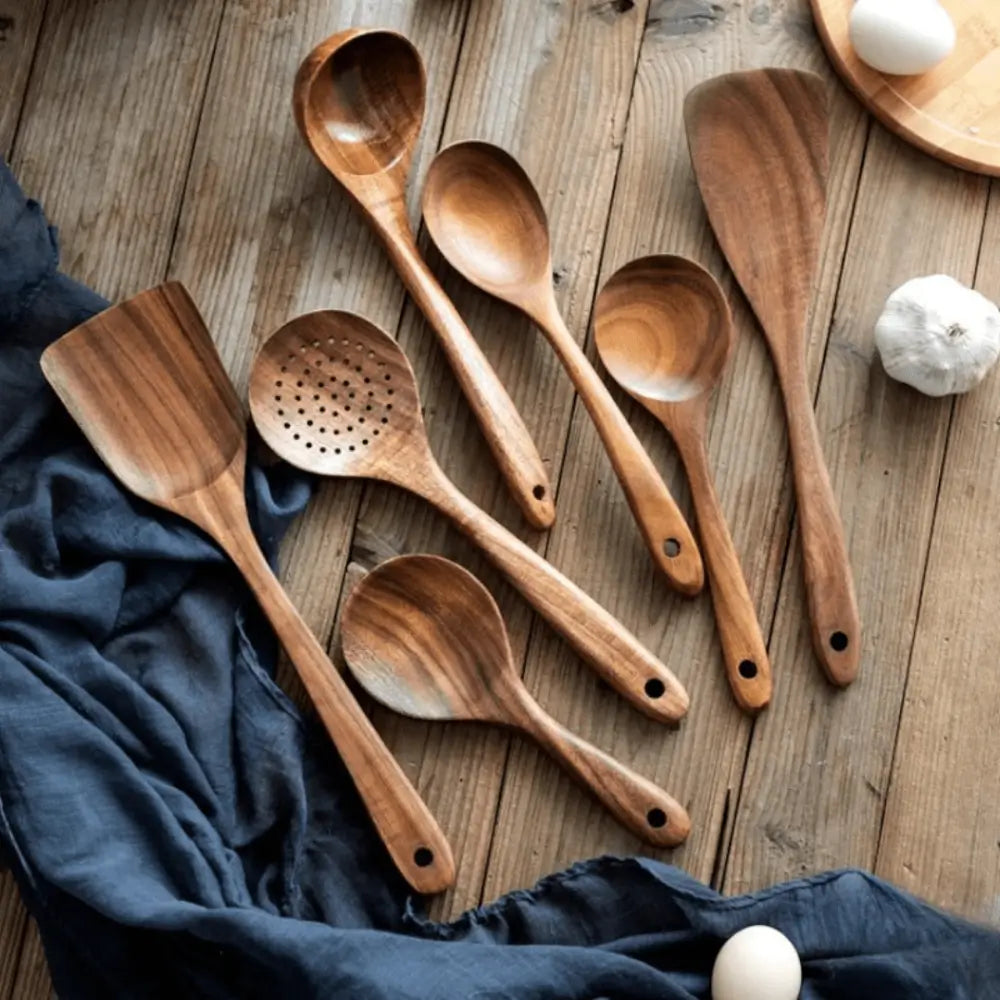
- Slotted spoon: lifts vegetables and dumplings while liquid drains away. The slots reduce surface contact with the pan.
- Solid spoon: for stirring sauces and stews. A rounded bowl reaches into the corners of a pan without digging in.
- Flat spatula with a straight edge: the workhorse for flipping eggs, pancakes, and fish. A thin, straight leading edge slides under delicate food.
- Angled turner: the offset head keeps knuckles off the hot surface and gives better use for lifting.
- Spurtle: a slender Scottish stirring stick, ideal for porridge, risotto, and sauces because it stirs without scraping the base.
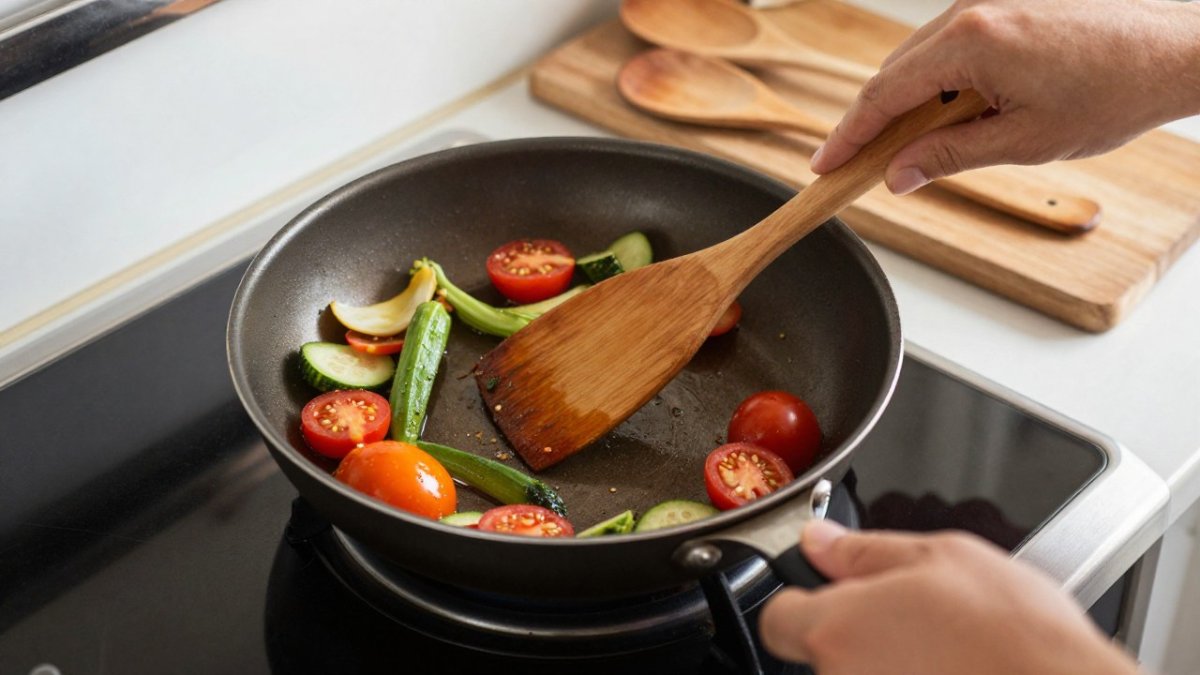
The shape most people overlook is the flat spatula. A turner with a wide, thin blade covers more of the pan in one motion, so the cook uses less downward force. That single change does more for coating longevity than any cleaning routine.
Wooden vs Silicone Utensils for Nonstick Pans
Wood wins on heat and longevity; silicone wins on flexibility and dishwasher tolerance. The honest answer is that most kitchens benefit from both, but if only one set is in the budget, wood is the more versatile choice for nonstick cooking.
Silicone utensils flex, which helps scrape the last bit of sauce from a pan, and they tolerate dishwashers and high heat without special care.
A common mistake is buying silicone solely because it claims to be coating-safe, then discovering the stiff core scratches anyway. Check the flexibility of the working edge before buying, in either material.
How to Inspect a Utensil Before It Touches Your Pan
A two-minute inspection at the store or on arrival prevents most coating damage. The checklist below is the one worth keeping on a phone.
- Run a fingernail along the working edge. Any roughness or splintering means it will scratch.
- Check the grain direction. Straight, tight grain resists splitting; wide, open grain absorbs water.
- Look for cracks, knots, or filled gaps near the head, where stress concentrates.
- Confirm the finish is smooth and sealed, with no tacky or dry patches.
- Weigh it in the hand. Balance should sit near the middle of the handle.
- Flex the head gently. A little give is fine; a wobbling joint is not.
- Smell it. A strong chemical odor suggests a finish that has not cured.
For a deeper walkthrough, see how to spot quality wooden kitchenware before buying.
How to Care for Wooden Cooking Utensils
Care comes down to three habits: wash by hand, dry completely, and oil regularly. Skip any one and even a good utensil will dry out, crack, or take on odors in the grain.
Wash wooden cooking utensils in warm water with mild soap, then dry them promptly with a towel and let them air dry before storage. Prolonged water exposure can swell the grain, so soaking and dishwashers are generally avoided. Once a month, or whenever the wood looks dry and pale, rub in a thin coat of food-grade mineral oil or a dedicated wood conditioner, let it sit, and buff off the excess.
Hygiene, Odors, and Stains
Wood is porous, which is the source of both its appeal and its main care question.
For everyday odor control, a paste of baking soda and water rubbed into the grain, left briefly, and rinsed away is a common approach. For stains, a light lemon-and-salt scrub is often used before re-oiling. Neither substitutes for drying, the single most important habit.
Watch out: a utensil that stays damp, especially one stored in a closed drawer or a crock with its head down, is the most common source of musty odors and dark spots. Let utensils air-dry upright, head up, before they go away.
When to Retire a Wooden Utensil
Wood does not last forever, and a worn utensil can do the very thing it was bought to prevent. Inspect the working edge every few months. Deep cracks, a split neck, a rough or splintering edge, or a finish that has worn through to bare, fuzzy grain are all signals to replace the piece.
A light refresh is different from a failure. If the wood is merely dry and pale, re-oiling restores it; a small rough spot can be smoothed with fine sandpaper followed by oil.
For the full routine, read how to maintain wooden kitchen utensils, and for product-specific guidance see the best oils and conditioners for wooden kitchenware.
Building a Coating-Safe Collection with ForestCraft
A coating-safe kitchen does not need dozens of tools. It needs a small, well-chosen set that covers stirring, flipping, lifting, and serving, made from species that hold up to daily use.
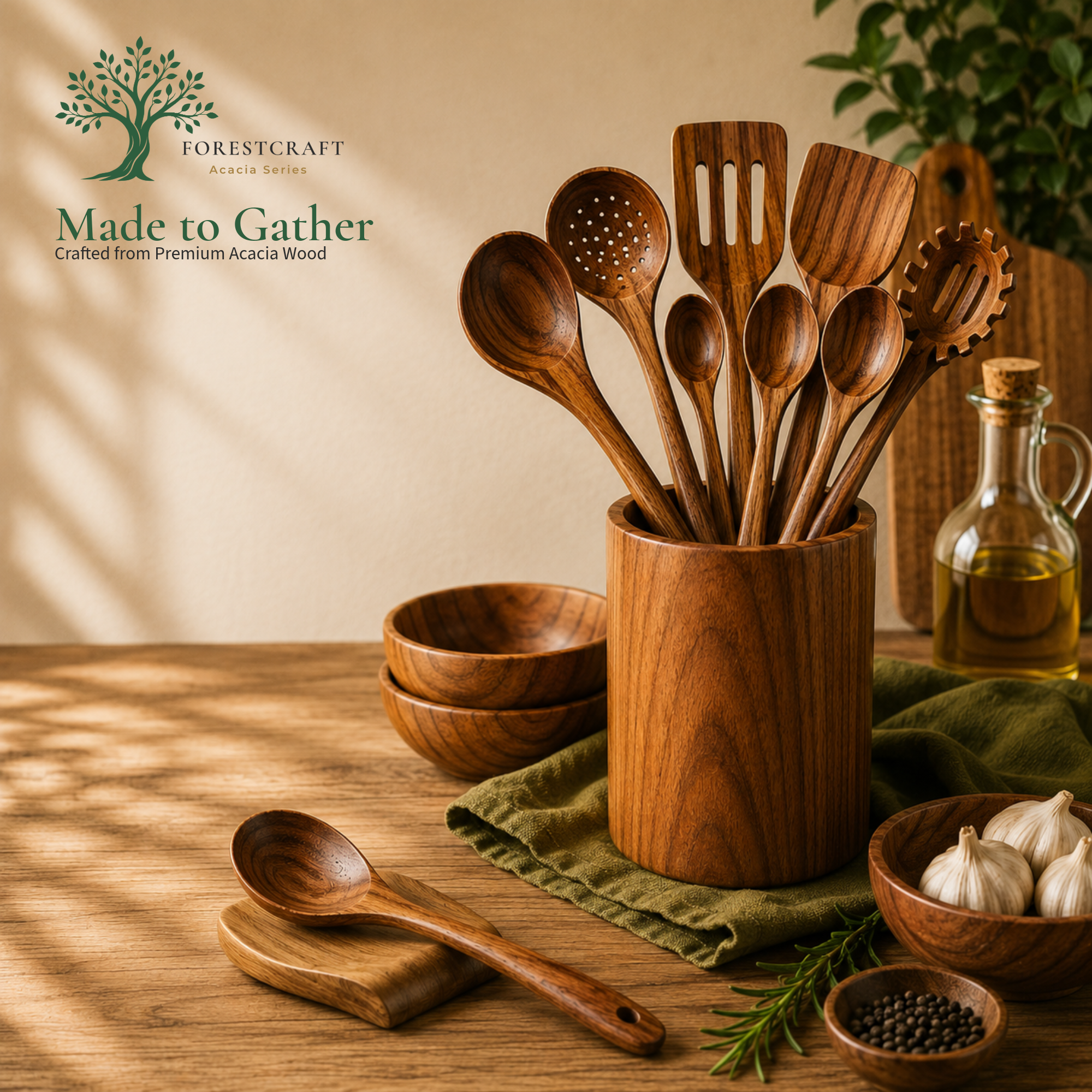
ForestCraft offers a range of wooden utensils. For buyers who want more visual character, the Acacia Small Leaf utensil sets are cut from richly grained acacia, with smooth edges and naturally varied grain, so no two sets look exactly alike. Readers who want to see the specific pieces can browse the full range of ForestCraft utensils and choose what fits their kitchen.
Best for: cooks who want a small, durable set for everyday stovetop cooking. Skip if: the priority is dishwasher-safe tools, since wood needs hand washing.
| Consideration | What to Look For | Why It Matters |
|---|---|---|
| Wood species | Teak or acacia for daily use | Resists moisture and wear |
| Edge | Thin, rounded, smooth | Slides under food without scraping |
| Balance | Weight near handle middle | Less wrist fatigue |
| Finish | Sealed, food-safe oil | Protects grain, easy to clean |
| Care | Hand wash, dry, oil monthly | Extends lifespan significantly |
Choosing wooden utensils for nonstick pans is a decision about everyday kitchen tools. Amari's ForestCraft collection pairs naturally oil-rich teak and richly grained acacia with balanced shapes built for daily cooking. Explore the ForestCraft kitchenware line to find utensils that protect your pans and look right on the counter.
Frequently Asked Questions
Are wooden utensils safe to use on nonstick pans?
Wood is generally softer than the coating on nonstick cookware, so a smooth, well-finished wooden spoon or spatula is commonly used on these surfaces. The key is the finish: look for sanded edges with no splinters, cracks, or rough grain that could catch and drag. Skip utensils with sharp corners or exposed hardware. Wooden cooking utensils also stay cooler in the hand than metal, which makes longer stirring tasks more comfortable.
Are wooden or silicone utensils better for nonstick pans?
Both are coating-safe, but they suit different jobs. Silicone is flexible, heat-tolerant, and dishwasher-friendly, which helps with scraping and baking. Wood brings rigidity for stirring and flipping, stays cool to the touch, and develops a patina with use. Many cooks keep both: silicone spatulas for scraping bowls and wood for the pan itself. If you want one material that handles most stovetop tasks, a wooden set covers stirring, folding, and serving well.
Can wooden utensils go in the dishwasher?
Hand washing is generally the recommended habit. Repeated dishwasher cycles can expose wood to high heat and prolonged moisture. Wash with warm water and mild soap, rinse, and dry thoroughly with a towel before storing. Avoid soaking wooden utensils. Periodic conditioning with a suitable mineral oil can help the wood stay conditioned.
Which wooden cooking utensils should a basic set include?
A practical starter set covers four jobs: a large spoon for stirring and serving, a slotted spoon for lifting vegetables out of liquid, a flat spatula or turner for flipping, and a spurtle or narrow spoon for reaching into deep pots. Check that each piece has a smooth, rounded edge and a balanced handle that feels comfortable in your grip. A matching wooden cooking utensils set removes the guesswork and keeps every tool coating-safe.
