Durable Kitchenware for Your First Apartment: An Essential Checklist

Table of Contents
- Why Durable Kitchenware Matters in Your First Apartment
- The Essential Kitchen Tools Checklist for Beginners
- Choosing the Right Cookware Materials That Last
- How to Spot Quality Wooden Kitchenware
- How to Care for Wooden Spoons and Cutting Boards
- Smart Storage and Budget Strategies for Small Kitchens
- Build Your Durable Kitchenware Collection Over Time
- Frequently Asked Questions
Last Updated: October 7, 2026
Setting up your first apartment kitchen does not require a large matching set or a drawer full of gadgets. Start with a few dependable tools that suit the meals you actually cook, fit your available storage, and feel comfortable to use. This checklist will help you decide what to buy first, what can wait, and how to evaluate kitchenware beyond its price tag.
Durability depends on more than the material name. Construction, intended use, and care all affect how well an item holds up. Below, you’ll find a practical starting list, the main cookware trade-offs, tips for choosing wooden utensils and bowls, and ways to build your kitchen gradually without stretching your budget.
Why Durable Kitchenware Matters in Your First Apartment
A first-apartment budget needs to cover more than the kitchen, so every purchase should have a clear purpose. Look for tools that suit your cooking habits, feel sturdy and comfortable, and come with clear care instructions. A lower-priced item can still be a good choice; paying more makes sense when the construction or features offer something you will actually use.
Versatile pieces help you make the most of limited storage. A saucepan can handle oatmeal, sauces, and small portions of pasta, while a mixing bowl can also serve a salad or side dish. Start with the essentials, then add tools as your cooking routine develops. This keeps your spending focused and leaves room for the items you reach for most.
The Essential Kitchen Tools Checklist for Beginners
Start with enough equipment to prepare the meals you make most often. Before buying a large set, check what you already own and choose individual pieces that fit your stove, cupboard space, and budget. A practical starter kitchen includes:
- A chef’s knife that feels comfortable and manageable in your hand
- A cutting board with enough working space that stays steady during use
- One frying pan suited to your stove and everyday meals
- A saucepan with a lid for sauces, grains, and small portions
- A mixing bowl that can also be used for serving
- A stirring spoon, spatula or turner, and kitchen tongs
- Measuring cups and spoons
- A colander or strainer
- An oven mitt or heat-resistant pot holder
- Food-storage containers for leftovers

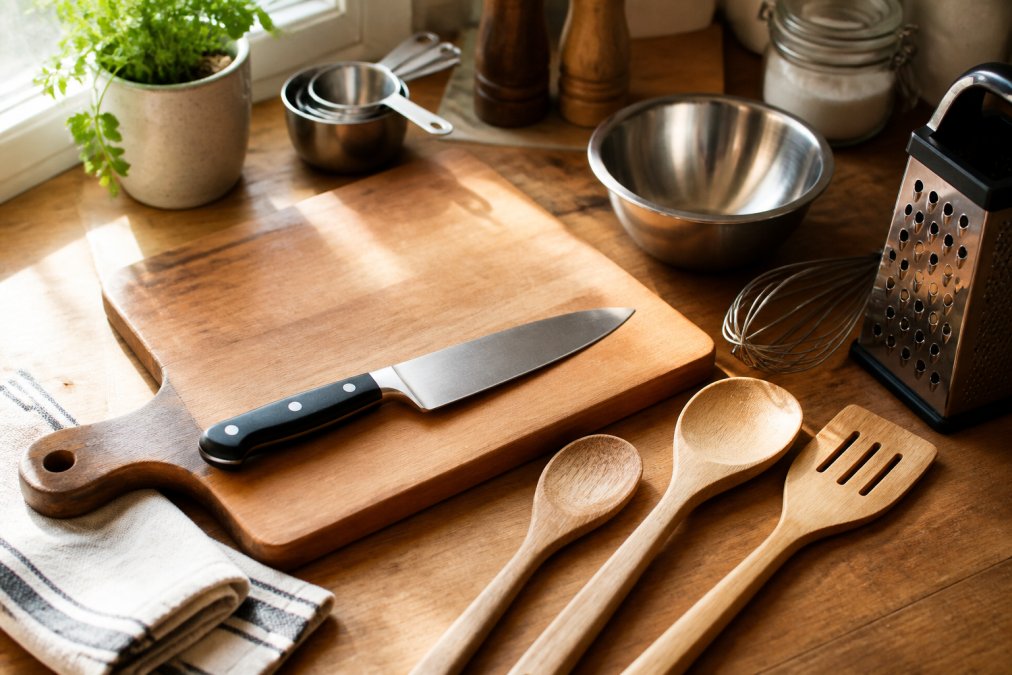
Check handles, weight, and dimensions before buying. A pan should be comfortable to lift, and its handle should feel secure. Choose utensils that the cookware manufacturer recommends for its surface; smooth wooden or suitable silicone utensils are often recommended for coated pans. Add baking equipment, specialty knives, and other gadgets when your recipes call for them.
Choosing the Right Cookware Materials That Last
Choose cookware around the meals you make and the care you are willing to give it. You do not need every material in your first kitchen. Before buying, check stove compatibility, weight, handle comfort, and the manufacturer’s oven and cleaning instructions.
Stainless steel is a versatile option for sauces, boiling, and browning. It has no nonstick coating, so cooking technique matters when preparing foods that tend to stick. Look for a well-constructed base or layered design intended to distribute heat evenly, rather than judging quality by weight alone.
Cast iron retains heat well and can suit searing or oven cooking when the pan’s instructions allow it. Traditional, uncoated cast iron needs thorough drying and care of its seasoned surface. It is also heavy, so check whether you can comfortably lift and clean it. Enameled cast iron has different care requirements and does not need the same seasoning routine.
Carbon steel is another option for cooks who enjoy browning and searing and are willing to maintain a seasoned surface. Its weight varies by size and construction. Like uncoated cast iron, it needs prompt drying and protection against rust.
Nonstick cookware can make eggs and other delicate foods easier to cook and release. Coatings vary, and none should be treated as a lifetime surface. Follow the manufacturer’s heat limits, cleaning guidance, and utensil recommendations, and replace a pan if its coating is peeling or otherwise damaged.
For a first apartment, one suitable frying pan and one saucepan with a lid may be enough to begin. Add a larger pot, baking dish, or specialty pan when your usual recipes call for it. Buying gradually gives you time to learn which sizes and materials work best in your kitchen.
How to Spot Quality Wooden Kitchenware
When choosing wooden utensils, bowls, or cutting boards, look beyond the wood species. Check for smooth surfaces, comfortable edges, and no visible cracks, splinters, or loose parts. Bowls and boards should sit steadily on a flat surface, while utensils should feel comfortable to hold. Natural grain and color variation are part of wood’s appearance; uniform coloring is not a requirement for quality.
Read the product information for the stated material, intended use, finish, and care instructions. A serving bowl is not automatically suitable for every mixing task, and a decorative wooden piece may not be intended for food contact. If finish or food-contact information is missing, ask the seller rather than assuming that “natural” means suitable. Choose dimensions that fit your cupboard space and the portions you normally prepare.
How to Care for Wooden Spoons and Cutting Boards
Simple care habits help keep wooden kitchenware clean and in good condition. Follow the product’s care instructions, since finishes and construction vary. Hand washing is a sensible default unless the manufacturer specifically permits dishwasher use.
Wash after each use with dish soap and water, removing food residue with a soft sponge or brush. Rinse thoroughly, towel dry, and allow the item to air dry completely before storing. Avoid prolonged soaking, and stand cutting boards on edge where air can reach both sides.
For wooden pieces that require conditioning, use food-grade mineral oil or a conditioner specifically intended for food-contact wooden kitchenware. Apply it only to clean, fully dry wood, following the conditioner’s instructions, and wipe away excess. Check the manufacturer’s guidance before oiling a coated or sealed piece; not every finish needs it.
Cleaning and conditioning serve different purposes. Oil does not sanitize wood or repair cracks. Use separate cutting boards for raw meat, poultry, or seafood and for ready-to-eat foods, and follow food-safety guidance for cleaning and sanitizing food-contact surfaces.
Inspect wooden tools regularly. Replace pieces with loose parts, deep cracks, persistent mold, or grooves that cannot be cleaned thoroughly. Avoid trying to close cracks with oil or reshape warped boards by soaking and weighting them.
For a more detailed routine, see our guide to maintaining wooden kitchen utensils.
Smart Storage and Budget Strategies for Small Kitchens
Measure your cupboards and drawers before buying larger pieces. Nesting bowls and stackable containers can make better use of limited space, while drawer dividers help keep smaller tools easy to find. Keep frequently used items within reach and store occasional-use equipment elsewhere. If you rent, check your lease before installing wall-mounted storage and follow the mounting hardware’s load limits.
Set a total kitchen budget, then prioritize the items you need for your usual meals. Spend more when a feature offers a practical benefit, such as a comfortable knife handle, a secure pan handle, or a bowl size that suits your cooking. Simple measuring cups, strainers, and storage containers may meet your needs without a premium price. Leave specialty cookware and large matching sets for later, once you know what you use regularly.
Build Your Durable Kitchenware Collection Over Time
Use your starter kitchen for a few weeks before adding more equipment. Notice which tools you reach for, what feels awkward, and whether a missing item repeatedly limits the meals you want to make. Those observations will help you choose your next purchase more confidently than a large shopping list.
Once your everyday cooking needs are covered, consider serving pieces that suit your household and the way you entertain. Explore the ForestCraft collection at Amari for wooden utensils, mixing bowls, and serving pieces. Check each listing’s dimensions, included items, and care instructions to choose pieces that fit your space and routine.
Stage |
What to buy |
What to check |
|---|---|---|
Start with everyday essentials |
Knife, cutting board, frying pan, saucepan with lid, mixing bowl, and basic utensils |
Comfortable handling, suitable sizes, stove compatibility, and clear care instructions |
Cover preparation and storage |
Measuring tools, strainer, oven mitt, and leftover containers |
Your usual recipes, cupboard space, heat limits, and cleaning requirements |
Add pieces as needed |
Larger pot, baking dish, or specialty tools |
Whether you will use them regularly and where they will be stored. |
Expand for serving |
Serving bowls, platters, and serving utensils |
Household size, entertaining habits, and whether existing pieces can do both jobs |
A useful first kitchen starts with a manageable set of tools, a realistic budget, and room to grow. Choose pieces for the meals you cook, care for them according to their instructions, and add equipment when a clear need arises. You do not need to complete your kitchen in one shopping trip.
Frequently Asked Questions
What cookware do you need for a first apartment?
Start with one frying pan and a saucepan with a lid, chosen for your stove and the meals you cook most often. Add a larger pot or baking dish if your usual recipes need one. Check dimensions, weight, handle comfort, and care instructions before buying. You can expand gradually instead of purchasing a large set immediately.
How can you tell whether kitchenware is well made?
Check for secure handles, smooth edges, stable bases, and no visible cracks or loose parts. Look for clear information about materials, intended use, and care. Weight, price, and wood species alone do not prove quality. Choose pieces that feel comfortable to use and fit your available storage.
How should you care for wooden kitchenware?
Follow the product’s care instructions. Unless dishwasher use is specifically permitted, wash wooden pieces by hand with dish soap and water, rinse, towel dry, and let them air dry completely before storing. Avoid prolonged soaking. If conditioning is recommended, use a product intended for food-contact wooden kitchenware. Oil does not sanitize wood or repair cracks.
Is it better to buy a kitchenware set or individual pieces?
Individual pieces let you choose exactly what you need and spread purchases over time. A small set can still offer good value if you will use every item and the sizes fit your kitchen. Compare the useful pieces, total cost, storage requirements, and care instructions rather than choosing by the number of items in the box.