How Long Should Wooden Kitchenware Last

Table of Contents
- The Expected Lifespan of Wooden Kitchenware
- How to Spot Quality Wooden Kitchenware Before You Buy
- When to Oil Wooden Cutting Boards and Other Utensils
- Is It Safe to Use Cracked Wooden Spoons and Other Damaged Pieces
- Daily Care and Maintenance to Extend Lifespan
- Signs It's Time to Replace Your Wooden Kitchen Tools
- Frequently Asked Questions
Last Updated: September 1, 2026
The Expected Lifespan of Wooden Kitchenware
Quality wooden kitchenware can last for many years—and in some cases decades—when it is well made and properly cared for. There is no fixed replacement schedule for a wooden spoon, cutting board, or serving utensil. Its useful life depends on the wood species, construction, frequency of use, exposure to moisture and heat, and ongoing maintenance. Rather than replacing wooden kitchenware simply because it reaches a certain age, its physical condition is usually the better guide.
The difference between kitchenware that fails prematurely and pieces that remain useful for years often comes down to three factors: the wood itself, how the piece was made, and how it is cared for after purchase. Understanding these variables helps explain why some wooden kitchenware lasts through years of family meals while other pieces may splinter, warp, or crack much sooner.
Wooden kitchenware generally lasts longer when it is made from durable, appropriately finished wood and protected from prolonged moisture exposure. Hardwoods commonly used for kitchenware—including teak, acacia, olive wood, and walnut—are valued for characteristics such as density, strength, grain structure, and durability. Construction matters as well: a sturdy utensil without weak joints or obvious defects is better positioned to withstand repeated kitchen use. Just as important is maintenance, because even high-quality wood can eventually crack, warp, or become rough when repeatedly soaked, overheated, or allowed to dry out excessively.
How to Spot Quality Wooden Kitchenware Before You Buy
Identifying quality before purchase can help you choose wooden kitchenware that is better suited for years of regular use. Look for durable materials, smooth finishing, comfortable weight and balance, and construction without obvious weak points. These details don't guarantee how long a piece will last, but they can help distinguish thoughtfully made kitchen tools from pieces more likely to deteriorate prematurely.
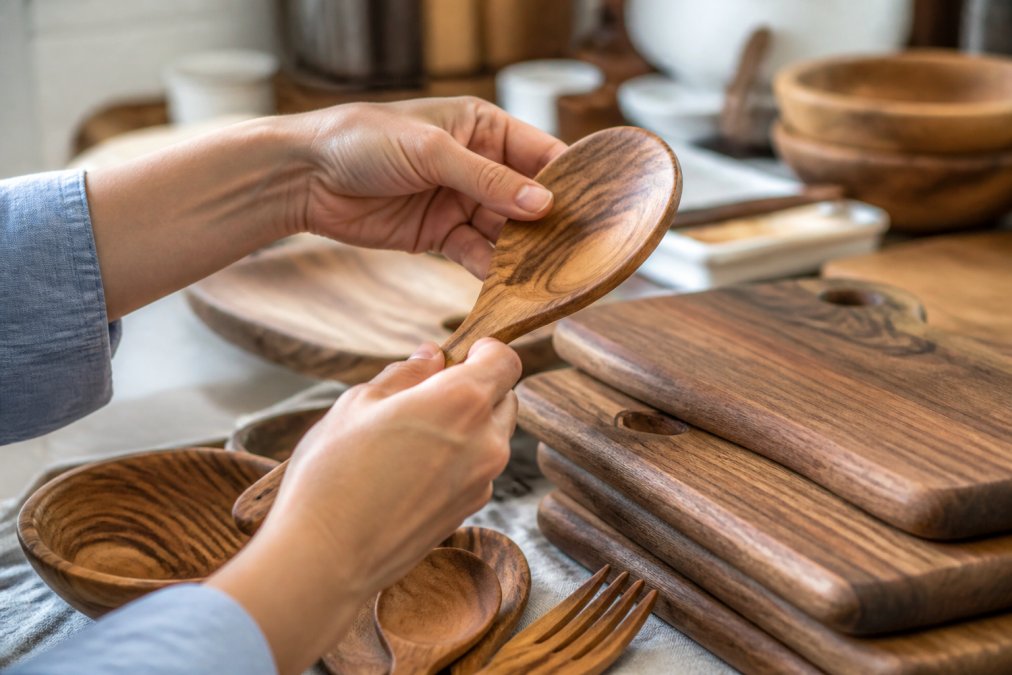
Wood Species and Durability
Wood species plays an important role in the durability, appearance, and feel of kitchenware. Teak is valued for its natural oils and resistance to moisture, while acacia is a dense hardwood known for strength and distinctive grain patterns. Olive wood brings warmth and density, and walnut combines strength with a rich, attractive grain. Other materials can perform well too, but their characteristics vary. Bamboo, for example, is technically a grass rather than a wood and is typically manufactured into kitchenware by joining strips or layers together. For any material, construction quality and proper care are just as important as the species itself.

Checking the product description for a clearly identified wood species is a useful first step when comparing wooden kitchenware. Knowing whether a piece is made from teak, acacia, olive wood, walnut, bamboo, or another material gives you a better basis for evaluating its expected characteristics and care requirements. Be cautious when a listing provides little more than a generic description such as “wood” or “hardwood,” especially when durability is an important part of your purchase decision. Food-safety guidance also recognizes appropriate uses for wood: the FDA Food Code allows hard maple or equivalently hard, close-grained wood for certain cutting boards, utensils, and related food-contact applications.
Craftsmanship and Construction Details
Construction quality can matter as much as the type of wood. For utensils such as spoons and spatulas, one-piece construction eliminates glued joints that could become potential weak points over time. For products intentionally made from multiple pieces—such as many cutting boards—look instead for tight, even joints with no visible gaps or separation. Edges and surfaces should feel smooth and properly finished, without raised fibers, rough patches, or splinters.
Weight, balance, and thickness can also provide useful clues. A well-made cutting board should feel stable on the work surface, while a wooden spoon or spatula should feel comfortable and balanced in the hand. Very thin sections may be more susceptible to damage under repeated use, while an appropriately substantial handle can provide both durability and a more secure grip. Above all, look for consistent workmanship throughout the entire piece.
When to Oil Wooden Cutting Boards and Other Utensils
Regular conditioning can help wooden kitchenware resist excessive drying and maintain a smoother surface over time. Food-grade mineral oil is a popular choice for unfinished wooden cutting boards and utensils because it penetrates the wood, is suitable for food-contact surfaces when used as directed, and does not become rancid the way some cooking oils can.
How often wooden kitchenware should be oiled depends on the piece, how frequently it is used, and how often it is washed. Rather than relying on a strict schedule, watch the wood itself. If the surface begins to look noticeably dry, pale, or rough—or absorbs water readily—it may be ready for conditioning. Apply food-grade mineral oil to a clean, completely dry surface according to the product directions, allow it time to absorb, and wipe away any excess before returning the piece to use.
Some wood-care products combine food-grade mineral oil with beeswax or other food-contact-safe waxes. These products can add a protective surface layer while enhancing the wood's natural appearance. Whatever product you choose, make sure it is specifically intended for wooden kitchenware or food-contact surfaces and follow the manufacturer's application instructions.
Is It Safe to Use Cracked Wooden Spoons and Other Damaged Pieces
A small surface crack doesn't necessarily mean a wooden spoon or utensil must be discarded immediately, but it should be treated as a warning sign. Cracks can deepen as wood repeatedly becomes wet and dries, and damaged surfaces are more difficult to clean thoroughly. Inspect the piece regularly and pay attention to whether the crack is growing, collecting food residue, or creating rough or loose fibers.
Deep cracks, significant splintering, or structural damage are stronger signs that replacement is appropriate. A crack that extends through a handle or other load-bearing area can weaken the utensil and increase the chance of breakage during use. Loose splinters or deteriorating fibers are also reasons to retire a piece, particularly when they could separate and end up in food.
Damage also makes wooden kitchenware harder to keep clean. Food residue and moisture can collect in deep cracks, splits, and heavily deteriorated surfaces that are difficult to reach during normal washing. This deserves particular attention with cutting boards and other surfaces that come into contact with raw meat, poultry, or seafood, where preventing cross-contamination is especially important.
A practical rule is to judge both the extent of the damage and whether the piece can still be cleaned and used reliably. Minor surface wear can often be monitored, and some roughness may be restorable with appropriate maintenance. But if a piece develops deep cracks, loose splinters, severe warping, persistent odors, or structural weakness, replacement is the better choice. Choosing well-made quality pieces and caring for them properly can help delay these problems and extend their useful life.
Daily Care and Maintenance to Extend Lifespan
Consistent daily care helps prevent many of the common problems that shorten the useful life of wooden kitchenware. The fundamentals are straightforward: hand wash promptly, dry thoroughly, store properly, and condition the wood when needed.
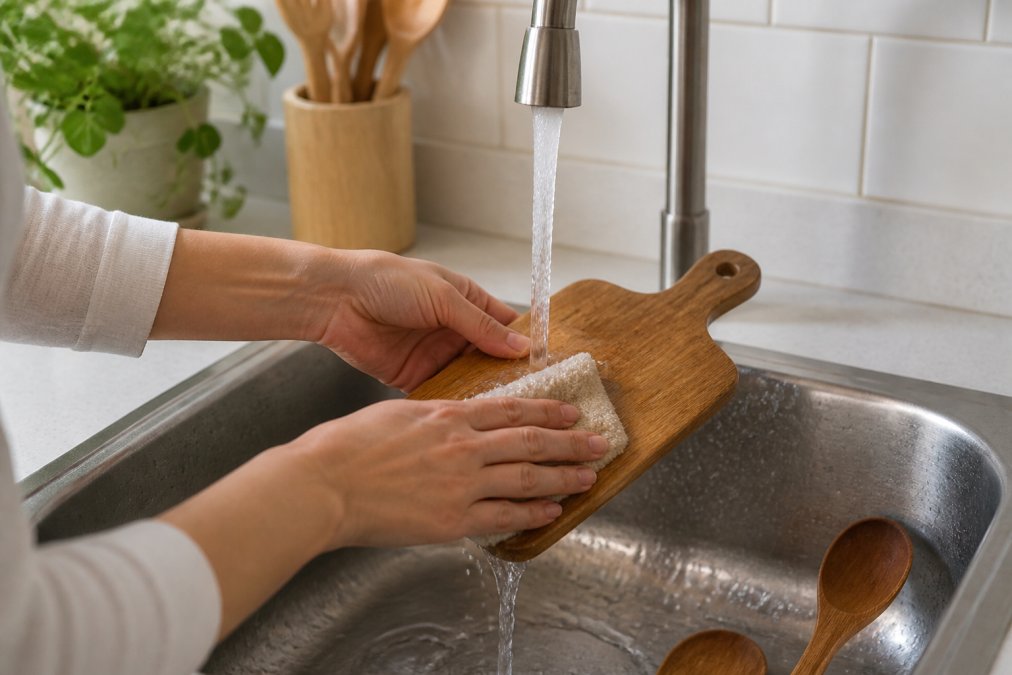
Hand Washing and Immediate Drying
Hand washing is the best approach for most wooden kitchenware. Dishwashers expose wood to prolonged moisture, high temperatures, strong detergents, and repeated wet-dry cycles that can contribute to warping, cracking, roughening, and deterioration of the surface. Unless the manufacturer specifically states that a wooden item is dishwasher-safe, wash it by hand instead.
Wash wooden pieces soon after use with warm water, mild dish soap, and a soft sponge or cloth. Avoid leaving them submerged in a sink or soaking them for extended periods. After washing, rinse thoroughly and towel-dry the piece, then allow it to finish drying with good air circulation before storing it. For cutting boards, standing the board on its edge while it finishes drying can help expose both sides to air.
Cutting boards used for raw meat, poultry, or seafood deserve particular attention because of the risk of cross-contamination. Wash the board thoroughly with hot, soapy water after use. For additional sanitizing, USDA guidance recommends a solution of one tablespoon of unscented liquid chlorine bleach per gallon of water; allow the solution to remain on the surface for a few minutes, then air-dry or pat dry with clean paper towels. Always follow product safety instructions when using sanitizers.
Proper Storage Practices
Store wooden utensils and cutting boards in a clean, dry location away from prolonged exposure to direct sunlight or strong heat sources. Wood naturally exchanges moisture with its environment, and changes in moisture content can affect its dimensions and physical properties, as explained by the USDA Forest Products Laboratory.
Good airflow is especially helpful for cutting boards. After washing, stand a board upright or on its edge until both sides are completely dry rather than leaving one damp surface flat against a countertop. Wooden utensils can be stored upright in a holder, hung from hooks, or placed loosely in a drawer once dry. Avoid tightly stacking pieces while they are still damp.
Avoid storing wooden kitchenware directly beside ovens, heating vents, radiators, or other locations that subject the wood to repeated extremes of heat or moisture. A stable, dry kitchen cabinet, drawer, utensil holder, or open shelf is generally a better environment for long-term storage.
Signs It's Time to Replace Your Wooden Kitchen Tools
Knowing when wooden kitchenware has reached the end of its useful life can help prevent frustration and potential food-safety concerns. Age alone isn't necessarily a reason to replace a wooden tool; its condition and ability to function and be cleaned properly are more useful indicators. Several signs can tell you when it's probably time to retire a piece.
Significant warping that interferes with normal use is a good reason to consider replacement. A cutting board that rocks or no longer sits securely on the counter can become frustrating or unstable during food preparation. Likewise, a severely distorted utensil may no longer perform as intended. Minor changes in shape aren't necessarily a problem, but damage that affects safe, reliable use shouldn't be ignored.
Visible splinters, loose fibers, or a surface that continues to become rough despite normal care indicate deterioration. Minor surface roughness may sometimes be addressed with appropriate maintenance, but pieces that repeatedly shed splinters or develop increasingly damaged surfaces are better candidates for replacement—especially when loose wood fibers could end up in food.
Deep cracks or splits, persistent unpleasant odors, visible mold growth, and other deterioration that cannot be corrected through normal cleaning are also warning signs. Discoloration by itself doesn't necessarily mean a wooden piece is unsafe; many woods naturally change color with age and use, and foods can leave stains. The greater concern is damage or contamination that persists despite proper cleaning and prevents the piece from being maintained in a clean, usable condition.
A dry or dull-looking surface doesn't automatically mean a wooden utensil or cutting board needs to be replaced. Unfinished or oil-finished wood may simply need conditioning. If appropriate cleaning and conditioning restore the surface and the piece remains smooth, structurally sound, and functional, it may have plenty of useful life remaining. Replacement becomes more appropriate when deterioration is structural or cannot be corrected through reasonable maintenance.
When choosing replacements, consider materials, construction, intended use, and care requirements rather than price or appearance alone. The ForestCraft Kitchenware collection includes kitchen tools made from woods such as teak, acacia, and olive wood, offering options for shoppers who value the natural character and durability associated with quality wooden kitchenware. Whatever wood you choose, proper washing, drying, storage, and conditioning remain important to its long-term performance.
Quality wooden kitchenware can remain useful for many years, but there isn't a universal expiration date for a wooden spoon, cutting board, or serving utensil. How long each piece lasts depends on the wood, construction, frequency of use, and—perhaps most importantly—how it is cared for. Hand washing, thorough drying, appropriate conditioning, proper storage, and regularly inspecting for damage can all help wooden kitchen tools remain functional and attractive for as long as possible.
When it is time to replace worn wooden kitchenware, look for durable materials, sound construction, smooth finishing, and pieces suited to the way you cook and serve food. ForestCraft offers wooden kitchenware made from materials such as teak, acacia, and olive wood for those who appreciate the warmth, character, and function of natural wood in the kitchen. Choosing thoughtfully and caring for each piece properly can help you get more useful life from the kitchen tools you bring into your home.
Frequently Asked Questions
How often should I replace wood cooking utensils?
Wooden cooking utensils don't need to be replaced according to a fixed schedule. A well-made utensil can remain useful for many years when properly cared for. Instead of replacing it based on age, inspect it regularly for deep cracks, significant splintering, structural weakness, persistent odors, or other damage that makes it difficult to clean or use reliably. Proper washing, thorough drying, and conditioning when needed can help extend its useful life.
When should you oil wooden cutting boards and other kitchen tools?
Condition wooden cutting boards and utensils when the wood begins to look or feel noticeably dry, dull, or rough rather than relying solely on a fixed schedule. How often this is needed depends on the type of wood, frequency of use, washing, and the manufacturer's care instructions. For unfinished wooden kitchenware, food-grade mineral oil or a conditioning product specifically intended for food-contact wood is a common choice. Apply it to clean, completely dry wood according to the product directions and wipe away any excess before use.
Is it safe to use cracked wooden spoons and utensils?
A small surface crack doesn't automatically mean a wooden utensil must be discarded, but it should be monitored carefully. Cracks can deepen over time and can make a piece more difficult to clean thoroughly. Replace utensils that develop deep or expanding cracks, loose splinters, structural weakness, persistent odors, visible deterioration, or damage that prevents reliable cleaning and use. When the condition of a piece makes you uncertain about its cleanliness or structural integrity, replacement is the safer choice.
Does the type of wood affect how long wooden kitchenware lasts?
Yes. Wood species can influence characteristics such as density, moisture response, strength, appearance, and durability. Teak, acacia, olive wood, and walnut are among the materials commonly used for quality wooden kitchenware, but wood species alone doesn't determine lifespan. Construction quality, frequency of use, washing and drying habits, storage, and ongoing maintenance also play important roles in how long a piece remains useful.