Mixing Bowls That Complement Kitchen Design in 2026

Last Updated: November 5, 2026
Quick Summary
Mixing bowls that complement kitchen design match the room's materials and colors, such as warm natural wood for rustic kitchens or stainless steel for professional-style spaces. Choose a shape that stacks neatly, a finish that holds up to daily use, and a limited palette that repeats tones already in the room.
- Match bowl materials to your kitchen style: natural wood suits warm, rustic spaces, while glass or ceramic suits bright, modern ones.
- Sample the cabinetry, countertop, and a hardware finish, then choose bowls that echo or deliberately contrast those tones.
- Limit a set to one or two surface types so the mix of finishes looks intentional rather than accidental.
- Keep the largest bowls neutral and let smaller bowls carry an accent color so the set stays flexible.
- Plan a set of three to five bowls around the tasks you repeat most, choosing sizes that nest together.
Table of Contents
- Why Mixing Bowls Belong in Your Kitchen Design
- Choosing Mixing Bowl Materials for Your Kitchen Style
- Color and Finish: Matching Colorful Mixing Bowls to Your Palette
- Stylish Mixing Bowls That Look Good on Open Shelves
- Mixing Bowls with Lids: Storage Without the Clutter
- Building a Mixing Bowl Set That Fits Your Cooking
- Start Matching Your Bowls to Your Kitchen Today
- Frequently Asked Questions
Why Mixing Bowls Belong in Your Kitchen Design
Mixing bowls are one of the few kitchen tools that stay visible all day. They sit on counters, stack in open cabinets, and often come out for serving. That visibility makes them part of the room's design, not just a utility item. Mixing bowls suit a range of kitchen styles, so the choice is as much about look as function.
The mixing bowls that complement kitchen design tend to share a few traits: a shape that stacks neatly, a material that looks at home beside other surfaces, and a finish that holds up to daily handling. Many home cooks find that a bowl they enjoy looking at gets used more often. That habit matters, because a bowl that comes out every day shapes how a kitchen feels in practice.
Design and function rarely pull in opposite directions here. A set with clean lines and a warm natural grain can fit a farmhouse counter and a modern minimalist shelf alike. The sections below cover materials, color, open-shelf display, lids, and how to build a set that fits the way you cook.
Choosing Mixing Bowl Materials for Your Kitchen Style
Material does more to set a kitchen's mood than almost any other choice in a bowl, and it also determines how the bowl behaves in daily use. The most useful approach is to judge each material on two axes at once: how it reads against your cabinetry, counters, and hardware, and how it handles weight, heat, cleaning, and the way you mix. A material that wins on looks but loses on upkeep tends to get pushed to the back of the cabinet.
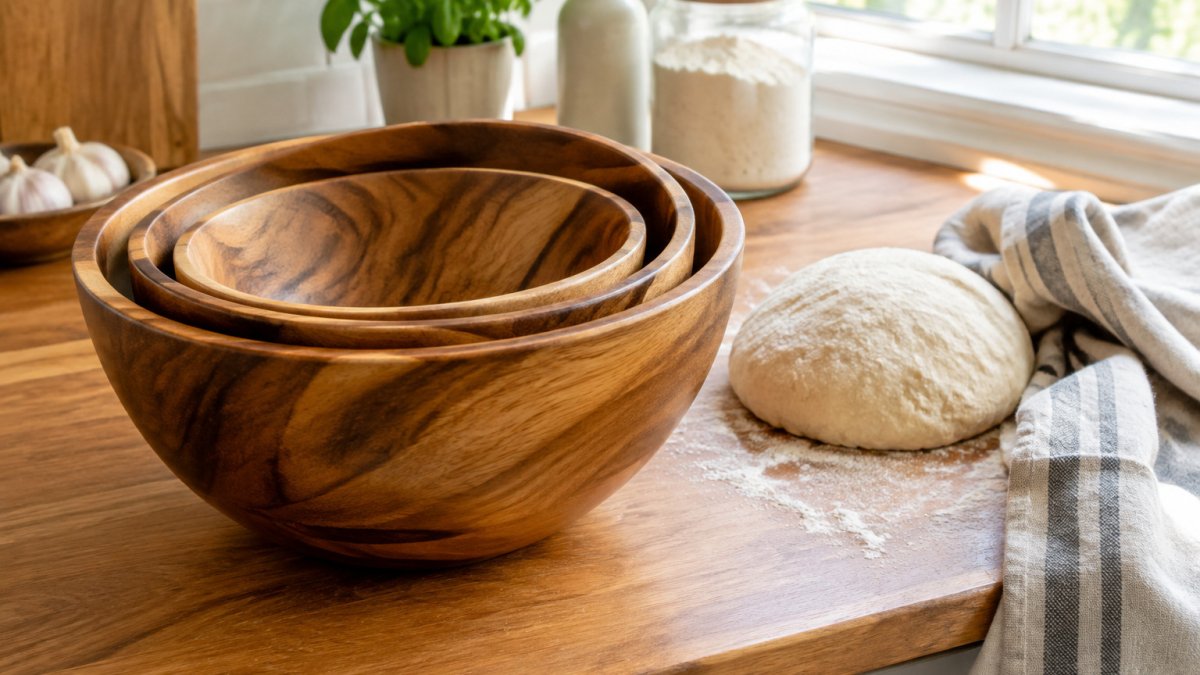
Natural wood (Acacia, Teak, Olive Wood, Walnut, Pakkawood). Wood brings warmth and texture that cool surfaces cannot match, which is why it sits comfortably beside butcher block, open shelving, and painted cabinetry. Acacia has a distinctive grain, and each bowl's pattern is its own, so a set reads as a collection rather than a matched product. Wood is comparatively light for its size and quiet against a counter. The trade-off is care: wooden bowls can stain or dull if left soaking or exposed to prolonged moisture. Readers weighing wood against other materials can find more guidance in How to Identify Durable Wooden Kitchenware.
Stainless steel. Steel suits professional-style and industrial kitchens, where it echoes appliance fronts, pot racks, and metal hardware. It is light for its volume, resists staining, and tolerates hot ingredients better than most alternatives. Its reflective surface shows fingerprints and water spots, though, and it can feel loud and scratch-prone over time. Steel is also opaque, so you cannot see how a mixture is coming together from the side.
Glass. Glass keeps clean lines and suits white, stone, and bright modern surfaces, and its transparency lets you watch browning, folding, and emulsifying without lifting the bowl. It is heavier than steel or wood at the same capacity and can chip at the rim if knocked, and thermal shock is a real risk if a hot mixture meets a cold bowl. Glass is generally dishwasher-friendly, which makes it a low-friction choice for frequent bakers.
Ceramic and stoneware. Ceramic brings a more formal, glazed look that pairs well with stone counters and painted cabinets. It is heavy and stays put during vigorous mixing, but that weight makes it tiring to lift when full, and it can chip or crack if dropped. Many ceramic bowls are hand wash only, so confirm care instructions before committing to a set you plan to use daily.
Silicone and plastic. These are typically chosen for lightness, nesting, and price rather than appearance.
Consider these pairings when matching material to your space:
- Warm, rustic kitchens: Natural wood pairs well with butcher block counters and open shelving.
- Bright, modern kitchens: Glass or ceramic keeps clean lines and suits white or stone surfaces.
- Professional-style kitchens: Stainless steel fits with metal hardware and a more technical look.
- Playful, family kitchens: Silicone or plastic keeps weight and replacement cost low.
Factor upkeep and handling into the decision, not just the finish.
The article compares common mixing bowl materials on how they suit a kitchen's look and how they handle daily use.
| Material | Best for | Key difference |
|---|---|---|
| Natural wood | Warm, rustic kitchens | Warmth and texture; needs hand washing and oiling |
| Stainless steel | Professional-style kitchens | Light, resists staining; shows fingerprints and scratches |
| Glass | Bright, modern kitchens | Transparent for watching mixtures; heavier, can chip |
| Ceramic and stoneware | Stone counters, painted cabinets | Formal glazed look; heavy and can chip or crack |
| Silicone and plastic | Playful, family kitchens | Lightweight and low cost; chosen mainly for price and nesting |
Color and Finish: Matching Colorful Mixing Bowls to Your Palette
Color is the fastest way to tie bowls into a room, but the most reliable method is to pull from what is already there rather than introduce a new palette. A practical approach is to sample three sources in the kitchen, the cabinetry or wall color, the countertop or backsplash, and one hardware or accent finish, and choose bowls that either echo one of those tones or deliberately contrast with them. A bowl in a shade already present in the room, such as the tone of a backsplash or a pendant light, looks intentional. A bowl in a contrasting color can serve as a deliberate accent.
Building a limited palette. Colorful mixing bowls work best when the palette stays limited. Choose one or two accent colors that repeat elsewhere in the room, such as a towel, a canister, or a bar stool. A set in a single color reads as calm and cohesive, while mixed colors suit a playful, eclectic kitchen. A common pattern is to keep the largest bowls neutral and let the smaller, more visible bowls carry the accent color, so the set stays flexible if the room's palette changes.
ForestCraft Acacia Mixing Bowls →
Coordinating with cabinetry and hardware. White and light-wood cabinets accept almost any bowl color but reward warm tones, terracotta, mustard, olive, and natural wood grain, that add depth without clashing. Dark cabinets and black hardware pair well with matte finishes and muted, saturated colors, while brass and copper hardware invite warm metallics and wood tones. Stainless appliances are the most neutral anchor and let a single accent color carry the room.
Finish matters as much as hue. Matte surfaces hide fingerprints and feel softer, while glossy finishes reflect light and look more polished. Natural wood has its own finish, so pairing it with matte ceramic or stone creates a balanced palette. Mixing too many sheens in one stack, high-gloss glaze beside brushed steel beside oiled wood, can read as unintentional, so limit a set to one or two surface types.
How finishes age. Long-term appearance is where color choices earn their keep. Glossy glazes can show utensil scratches and crazing over time, matte finishes can scuff, and metal can dull or spot. Wood darkens and deepens with oiling but can stain from turmeric, berries, and tomato. Choosing a finish you are willing to maintain, and a color that hides the wear you expect, keeps a set looking deliberate for years rather than months.
Watch out: a bold accent color chosen in isolation can feel out of place once the room's other elements are in view, so test a bowl against the counter and cabinets in daylight before committing to a full set.
Stylish Mixing Bowls That Look Good on Open Shelves
Open shelving puts bowls on display, so their shape and surface are always visible. Bowls with a smooth exterior and even proportions tend to look tidy on a shelf. Nesting sets save space and create a neat stack that reads as one unit.
When styling open shelves, group bowls by size and keep the largest on the bottom. Leave some empty space so the arrangement does not feel crowded. Stylish mixing bowls also serve as décor between uses, so choose pieces whose grain or glaze you are happy to see every day.
Mixing Bowls with Lids: Storage Without the Clutter
Lids solve a practical problem. They let you cover prepped ingredients, store leftovers, or move a mixture without spilling. Lidded bowls also reduce the number of loose containers in a cabinet, which keeps the kitchen looking less cluttered.
Look for lids that fit snugly and stack with the bowl. Some lids are sold separately, so confirm the fit before buying. A lidded bowl in a visible spot can double as a serving piece, which makes it useful beyond prep work.
Building a Mixing Bowl Set That Fits Your Cooking
A useful set starts with the tasks you repeat most. Baking requires a large bowl for dough and a medium one for batter. Everyday cooking calls for several sizes for prepping vegetables and tossing salads. Many cooks find that three to five bowls cover most needs.
Plan the set around capacity rather than count. Choose a range of sizes that nest together to save storage space. Keep in mind that wooden bowls need hand washing and periodic oiling, so a set you use often should suit your cleaning routine. If you want help choosing wooden pieces that suit your routine, the ForestCraft Kitchenware collection brings together natural-material pieces designed for everyday prep and serving. For care guidance, see How to Maintain Wooden Kitchen Utensils. For a sense of how long wooden kitchenware should last, read How Long Should Wooden Kitchenware Last.
Start Matching Your Bowls to Your Kitchen Today
Begin with the room you spend the most time in. Note its dominant materials and colors, then choose bowls that either echo them or contrast with them on purpose. Start with the sizes you use most, and add pieces as your cooking changes.
The ForestCraft Acacia Mixing Bowls are available at $89.99. Shop Today!
Frequently Asked Questions
How do you choose mixing bowls that match your kitchen?
Start with the surfaces you already have. Warm wood tones, white ceramic and brushed metal each pair with different cabinet finishes and countertops. Look at the bowls you would leave out on display, then match their finish to your hardware and appliances. Size matters too: choose a range from small to large so the set covers whisking eggs, tossing salads and mixing batters. A bowl you enjoy seeing every day will get used more often than one tucked away in a cabinet.
Are stainless steel mixing bowls stylish enough to leave on the counter?
Stainless steel suits modern and industrial kitchens, and its clean, reflective finish looks tidy when bowls are stacked. Where it falls short for some homes is warmth: it reads as utilitarian rather than decorative. If you want bowls to stay out as part of the décor, consider pairing steel with wood accents or choosing a material with more natural character.
Are mixing bowls with lids useful for everyday cooking?
Yes, lids help when you are proofing dough, marinating ingredients or storing leftovers in the refrigerator. A fitted lid keeps food covered and reduces the need for extra plastic wrap. When choosing bowls with lids, check that the lid fits the bowl snugly and is easy to remove with one hand. Because lids add pieces to wash, look for a design that suits your dishwasher or hand-washing routine. Lids also make a bowl double as a storage container on an open shelf.
What should you look for in a mixing bowl set?
Look for a range of sizes that nest together to save cabinet space, a stable base that will not slide on the counter and a rim that makes pouring easy. Consider the materials you prefer for durability and care, and whether the bowls share a consistent look so the set feels cohesive on your shelves. A well-chosen set covers the small tasks, like cracking eggs, and the larger ones, like kneading dough, without leaving you short on capacity.
