Eco-Friendly Alternatives to Plastic Kitchen Sponges

Last Updated: November 20, 2026
Quick Summary
Eco-friendly alternatives to plastic kitchen sponges include cellulose sponges made from wood pulp, reusable cotton or cellulose dishcloths, dried loofah gourds, and wooden brushes or copper scourers. Match abrasion level to your surface, confirm the named material on the label, and choose tools that dry quickly between uses.
- Cellulose sponges suit everyday wiping and light scrubbing but break down faster under aggressive use.
- Many cellulose sponges carry a thin synthetic scrub layer, so check the full material list.
- Loofah dries faster than cellulose but stiffens as it dries and should be avoided on nonstick.
- Cost per use favors tools that can be washed and dried over disposable foam sponges.
- A sponge with a plastic scrub layer will not break down in a home compost pile.
Table of Contents
- Why Plastic Kitchen Sponges Are Worth Replacing
- The Main Material Categories, Compared
- How to Find the Best Plastic-Free Dish Sponge for Your Sink
- What a Cellulose Kitchen Sponge Can and Cannot Do
- Reusable Dishcloths for Washing Dishes: The Everyday Workhorse
- Loofah, Copper, and Wood: Matching the Tool to the Task
- Cost per Use, Replacement Frequency, and End-of-Life Disposal
- Building a Plastic-Free Dishwashing Routine with ForestCraft
- Frequently Asked Questions
Why Plastic Kitchen Sponges Are Worth Replacing
Most kitchen sponges are made from polyurethane foam, a petroleum-based plastic. That single fact drives a growing number of home cooks to look for eco-friendly alternatives to plastic kitchen sponges. This guide from Amari walks through the materials, the trade-offs, and the practical routine that makes the swap work.
The case for switching rests on three points: what the material sheds, how often it needs replacing, and where it ends up. A buyer who understands those three things can choose with confidence instead of guesswork.
What Sheds, What Lingers, and What It Costs You
Foam sponges wear down with use. Small particles break away during scrubbing and travel down the drain. How much reaches waterways, and what it does there, is still an active area of research, so treat sweeping claims with caution. What is clear is that a sponge is a short-lived item. Many households replace them regularly, which adds up over a year.
Watch out: a damp sponge left in the sink basin stays wet for hours, and that trapped moisture is what makes it smell. Drying matters more than most people expect.
Curious how to separate genuine material claims from marketing spin? How to spot greenwashing in home goods breaks down the questions worth asking before buying.
The Main Material Categories, Compared
The best plastic-free dish sponge depends on the job, the cookware, and how the tool dries between uses. Four material families cover nearly every option on the market, and each behaves differently against grease, baked-on food, and delicate surfaces. The table below maps each family to the tasks and surfaces it handles well, along with realistic lifespan and the end-of-life path a buyer should expect.
| Material | Best For | Abrasion Level | Typical Lifespan | Cookware Compatibility | End-of-Life Path |
|---|---|---|---|---|---|
| Cellulose (wood pulp) | Everyday wiping, glasses, light scrubbing | Low | Weeks to a few months | Glass, ceramic, nonstick (gentle), stainless | Home compost if no plastic scrub layer; otherwise landfill |
| Reusable cloth (cotton, cellulose-cotton blend) | Dishes, counters, spills | Low to medium | Months | Glass, ceramic, nonstick, stainless | Wash and reuse; compost cotton at end of life |
| Loofah (dried gourd) | Pots, pans, textured surfaces | Medium | Weeks to a few months | Stainless, cast iron, ceramic; avoid on nonstick | Home compost |
| Wood and copper | Baked-on food, cast iron | High | Months to years | Cast iron, stainless; copper pads on enamel; avoid on nonstick | Wood composts; copper is recyclable |
Cellulose and cloth handle the bulk of daily washing. Loofah adds texture for pots and pans. Wood and copper take on the stubborn jobs. The practical rule is to match abrasion to surface: a copper scourer or stiff wooden brush will dull a nonstick coating, while a soft cellulose sponge will not lift burnt sugar from a skillet.
A detail often overlooked is mixed-material construction. Many cellulose sponges carry a thin abrasive scrub layer bonded to the plant-fiber body, and that layer is frequently a synthetic plastic. A product marketed as natural can therefore be part cellulose and part plastic, which changes both its disposal path and how it should be described. The same applies to cloths with polyurethane backing or scrub dots. Reading the full material list, not just the headline fiber, is the only reliable way to know what will happen to the tool at end of life.
Drying behavior also differs by family. Cellulose holds water in its open cells and needs airflow to dry; a cellulose sponge left flat in a sink basin stays damp for hours. Loofah dries faster because of its open fiber structure but stiffens as it dries. Cloth dries slowly when folded and quickly when hung. Wood brushes dry best standing bristle-down or hanging, and copper pads air-dry almost immediately. These differences matter more than most buyers expect, because a tool that stays wet between uses develops odor faster and needs replacing sooner.
For a wider look at how these fit alongside other tools, sustainable kitchenware for daily use puts the choice in context.
How to Find the Best Plastic-Free Dish Sponge for Your Sink
Start with the task, not the label. A sponge that scrubs cast iron will scratch a non-stick pan, and a soft cloth will not lift burnt sugar from a skillet. Match the tool to the surface first.
Second, check what the material actually is. A product described as natural should name the fiber: cellulose from wood pulp, cotton, or loofah. Vague wording is a signal to keep looking.
Third, think about drying. Anything that stays wet between uses will develop odor faster. A tool that airs out well lasts longer and feels cleaner.
- Identify your most common cleaning task
- Confirm the named material on the label
- Check how quickly it dries
- Decide whether it can be washed or composted
What a Cellulose Kitchen Sponge Can and Cannot Do
A cellulose kitchen sponge is a plant-fiber sponge made from wood pulp, and it behaves much like a traditional foam sponge when wet. It absorbs well, releases water easily, and feels soft against dishes.
What it does well: wiping counters, washing glasses, and light scrubbing. What it does not do: heavy scouring. Cellulose breaks down faster under aggressive use, and it still needs to dry between jobs. Many cellulose sponges also carry a thin abrasive layer, so check whether that layer is plant-based or plastic before assuming the whole product composts.
Reusable Dishcloths for Washing Dishes: The Everyday Workhorse
Reusable dishcloths for washing dishes are the quiet hero of a plastic-free sink. A cotton or cellulose cloth handles plates, glasses, and countertops, then goes in the wash and comes back ready.
The practical advantage is volume. One cloth replaces a long run of disposable sponges, and washing resets it rather than replacing it. Swedish dishcloths, a stiff cellulose-cotton blend, dry quickly and hold up to repeated washing.
The catch is hygiene. A cloth used on raw meat juices should not then wipe a cutting board for salad. Keep a separate cloth for those jobs, and wash frequently.
Loofah, Copper, and Wood: Matching the Tool to the Task
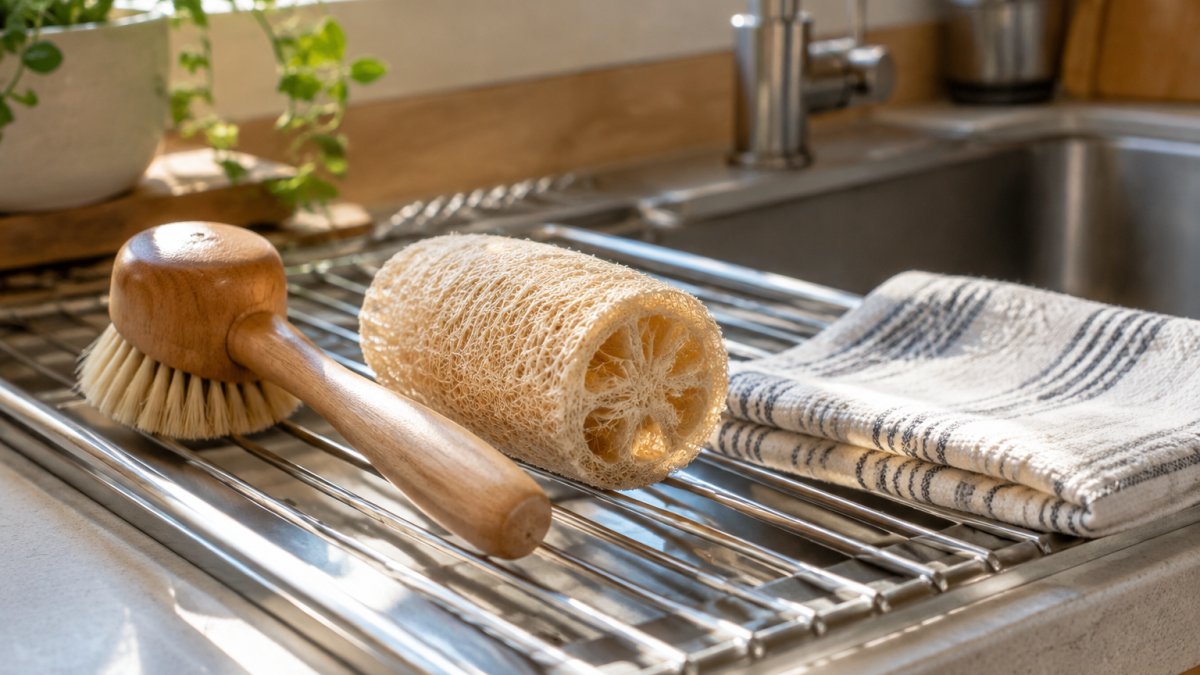
Loofah is a dried plant gourd that scrubs without scratching most surfaces. Copper scourers lift baked-on food from pots. Wooden dish brushes reach into corners and last for months with care.
A common mistake is buying one tool and expecting it to do everything. A practical approach is a small kit: a soft cloth for daily washing, a loofah for texture, and a wooden brush or copper pad for harder jobs.
Cost per Use, Replacement Frequency, and End-of-Life Disposal
A cheap sponge replaced often can cost more over a year than a durable tool bought once. Cost per use is the honest comparison, and it favors items that survive repeated washing. The framework is simple: divide the purchase price by the realistic number of uses before the tool wears out or becomes unpleasant to keep. A disposable foam sponge replaced every few weeks lands at a high cost per use because its lifespan is short. A cotton cloth washed and reused for months spreads its price across far more uses. A wooden dish brush that lasts a year or more does the same.
Replacement frequency follows from the same logic. Cellulose sponges and loofah scrubbers tend to wear out within weeks to a few months under daily use, and sooner if they stay wet. Cloth lasts months with regular washing. Wooden brushes and copper pads last months to years with basic care. A buyer who tracks how long each tool actually lasts will find that the upfront price is a poor predictor of annual cost.
Disposal is the other half of the equation, and it is where marketing language most often outruns reality. Cellulose and loofah can break down in a home compost pile under the right conditions. A sponge with a plastic scrub layer will not break down in a home pile, and many municipal programs will not accept mixed-material sponges either. Cloth made from cotton can be composted at end of life, though blends with synthetic fibers may not. Wooden tools last for years and the wood can often be composted once the tool is retired. Copper is recyclable through metal recycling streams.
The caveat competitors miss is that "compostable" is not a single category. A product may be home-compostable, commercially compostable only, or neither, and the label does not always make the distinction clear. Mixed-material products are the most common source of confusion: a cellulose sponge with a plastic scrub layer, a cloth with a synthetic backing, or a wooden brush with nylon bristles each contains at least one component that will not break down in a home pile. Separating components before disposal, where possible, is the practical way to keep compostable material out of landfill and plastic out of the compost.
To plan longevity properly, it helps to know how long wooden kitchenware lasts and how maintaining wooden kitchen utensils extends that timeline with simple care.
Building a Plastic-Free Dishwashing Routine with ForestCraft
A routine beats a single purchase. Keep a cloth for daily washing, a textured scrubber for pots, and a wooden brush for reach. Wash cloths often, dry everything between uses, and replace only what wears out.
Wooden tools round out that setup. The ForestCraft Kitchenware collection offers teak and acacia utensils, alongside a Korean-inspired wooden spoon set for serving.
The real challenge is not finding one replacement sponge. It is building a small, durable set that handles every job without falling back on plastic. Amari curates kitchenware chosen for materials and longevity, including ForestCraft teak and acacia utensils that are gentle on cookware and built to stay in the kitchen for years. Explore the collection and set up a sink that works harder with less waste. Get started with Amari and build a kitchen routine designed to last.
Frequently Asked Questions
Do kitchen sponges release microplastics?
Plastic foam sponges break down as you scrub, and small particles can rinse down the drain with the wash water. The exact amount varies by sponge type, how often you use it, and how worn it is, so treat any single figure with caution. A sponge made from cellulose, cotton, loofah, or wood does not contain plastic foam to begin with.
Are cellulose sponges plastic-free?
Most cellulose sponges are made from wood pulp, which is plant-based and biodegradable. The catch is the scrub layer: many cellulose sponges have a bonded abrasive pad made of plastic or an adhesive that holds it on. Check the listing for a plant-based scrub side or a sponge with no bonded pad at all. A cellulose kitchen sponge without a plastic scrub layer can usually go into home compost once it is worn out.
How often should I replace a natural dish sponge?
Natural sponges and cellulose sponges tend to wear faster than plastic foam because the fibers break down with use. A cellulose sponge or loofah is typically replaced once it begins to soften, fray, or hold odor. Reusable dishcloths last longer when you rotate between several and launder them often.
How do you clean and care for reusable dishcloths?
Rinse a reusable dishcloth after each use and wring it out fully, since a cloth left damp develops odor quickly. Launder cloths every few days with your regular kitchen towels, and hang them to dry rather than leaving them balled up in the sink. Keep two or three in rotation so one is always dry. A cloth that smells sour even after washing has reached the end of its useful life.
